Key takeaways
- Do not judge the day by air temperature. Check humidity, the “feels like” temperature, and the heatstroke alert too.
- The Ministry of the Environment says humidity has the largest influence on the heat index (WBGT).
- Plan fewer stops than usual. Build the day around spending the hottest hours indoors.
- Cooling items help, but they do not replace drinking, salt, and rest in a cool place.
- Domestic travel peaks around Obon in mid-August. Book what you can book early.
Summer has things you cannot see in any other season
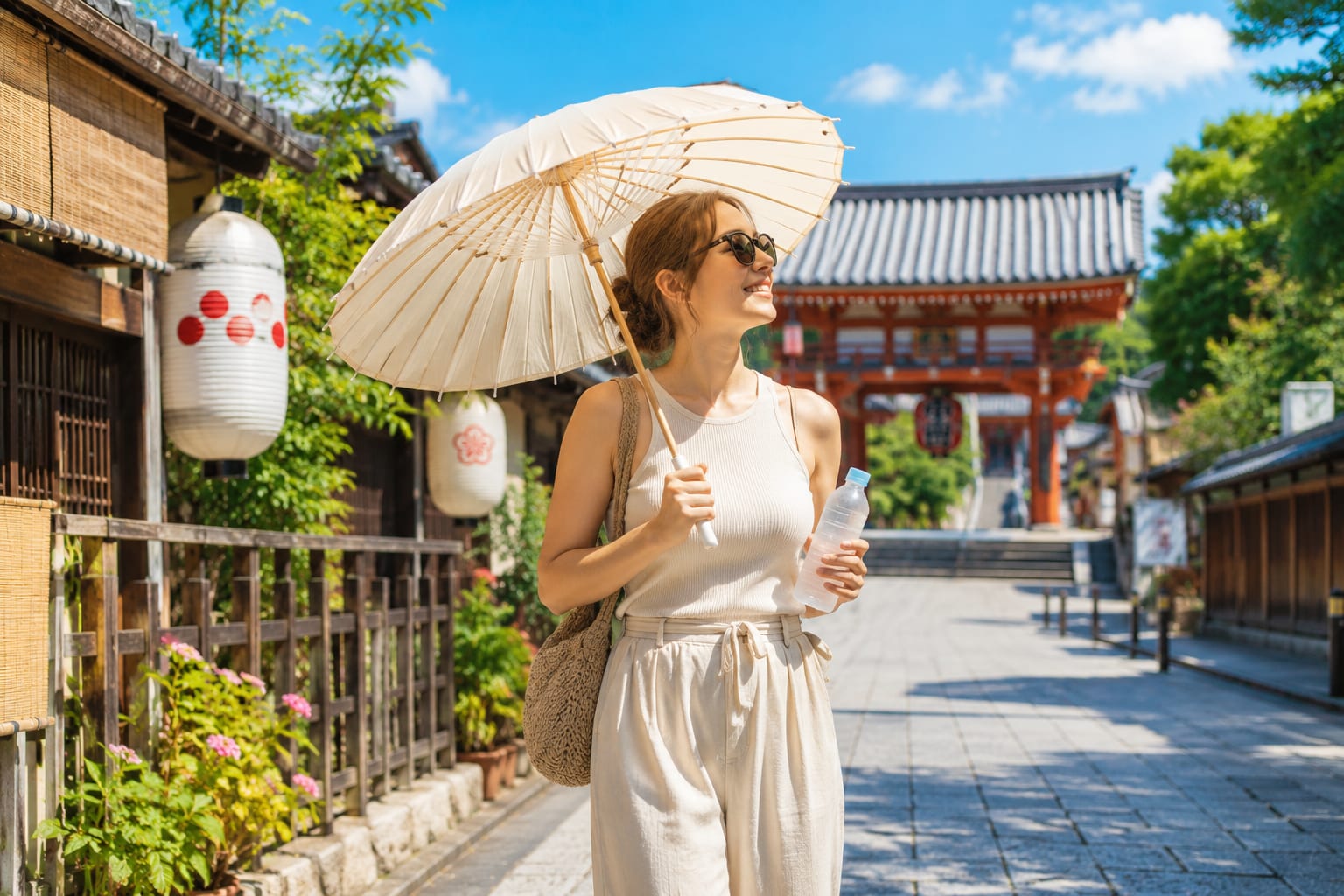
Summer in Japan has fireworks displays, local festivals, swimming, and rivers to play in. JNTO notes that July and August bring celebrations across the country, from small towns to large city displays.
The thing summer visitors have to plan for is the combination of heat and humidity.
If you look only at the temperature in the forecast, you will misjudge how hot the day actually feels. To avoid losing days of your trip to feeling unwell, it helps to understand the climate first and then plan a lighter schedule.
This guide covers what to watch out for, and which cooling items you can buy once you are here.
Japan feels hotter than the temperature suggests
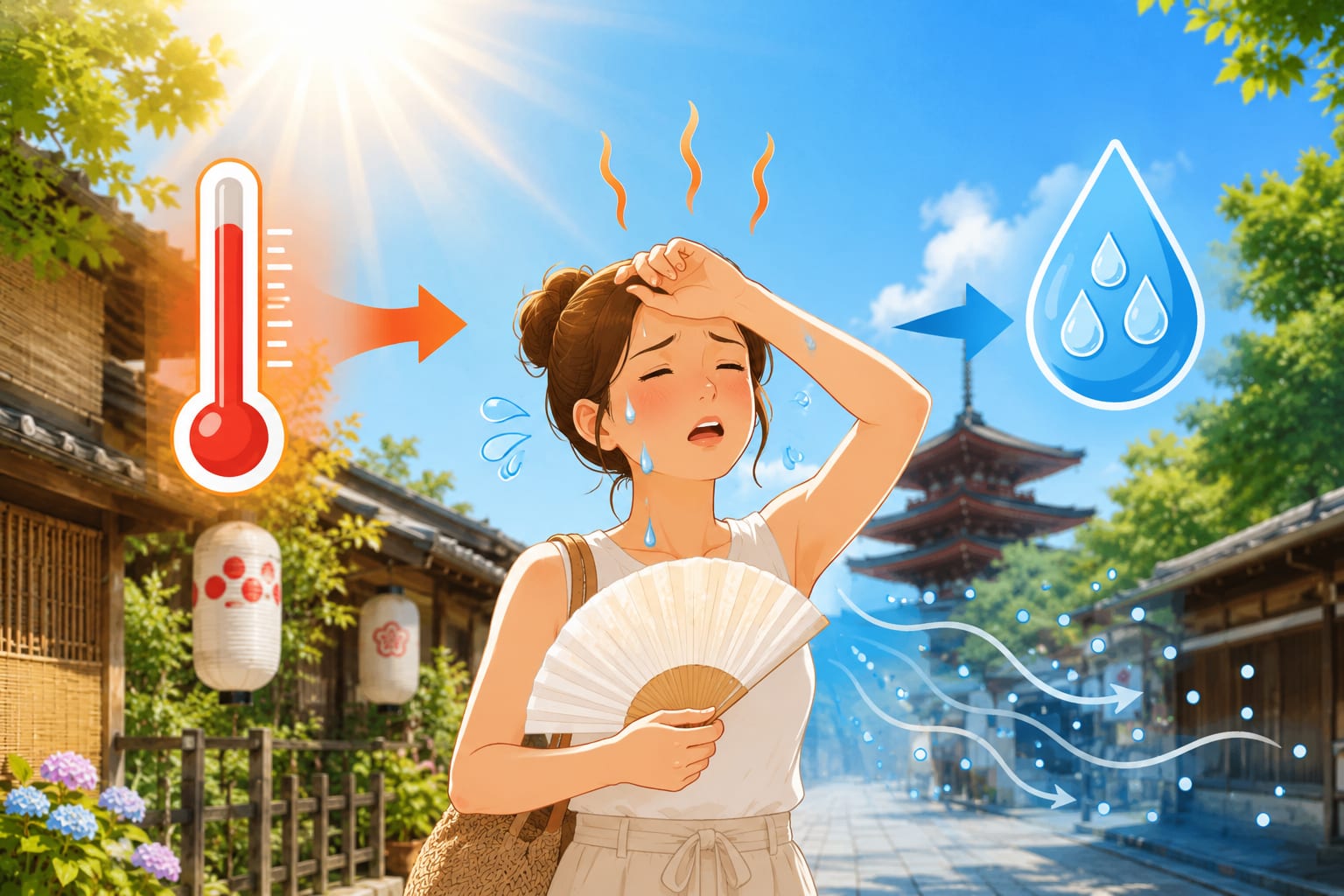
Japanese summers are not only hot. They are humid. JNTO describes most of the country in summer as hot and humid.
When humidity is high, sweat evaporates slowly. Sweat cools you as it evaporates, so that cooling works less well in humid air. The same temperature then feels hotter than you expect.
The Ministry of the Environment explains the heat index (WBGT) as a combination of humidity, radiant heat, and air temperature. Humidity has the largest influence of the three. So two days with the same temperature can put very different loads on your body.
Checking the temperature and deciding “that number looks fine” is the mistake to avoid.
Before you travel, and again before you go out, check:
- Air temperature
- Humidity
- The “feels like” temperature
- The heatstroke alert
- What time of day the peak temperature arrives
The heatstroke alert is issued by the Ministry of the Environment. It is issued when the forecast daily maximum heat index reaches 31 or above, and it is updated three times a day: at 05:00 JST for that day, and at 14:00 and 17:00 JST for the next day. It is easy to miss if you are checking Japanese weather in English, so look for it on purpose.
Cities such as Tokyo and Osaka also hold heat in their roads and buildings. The Japan Meteorological Agency reports that annual mean temperatures have risen faster at heavily urbanised sites than at the 15 sites where urbanisation has less effect. The rise is 1.8°C per 100 years averaged across those 15 sites, compared with 3.5°C in Tokyo and 2.8°C in Osaka.
Even if you handle heat well at home, walking for hours in a new city uses more energy than you expect.
Keep a drink with you at all times
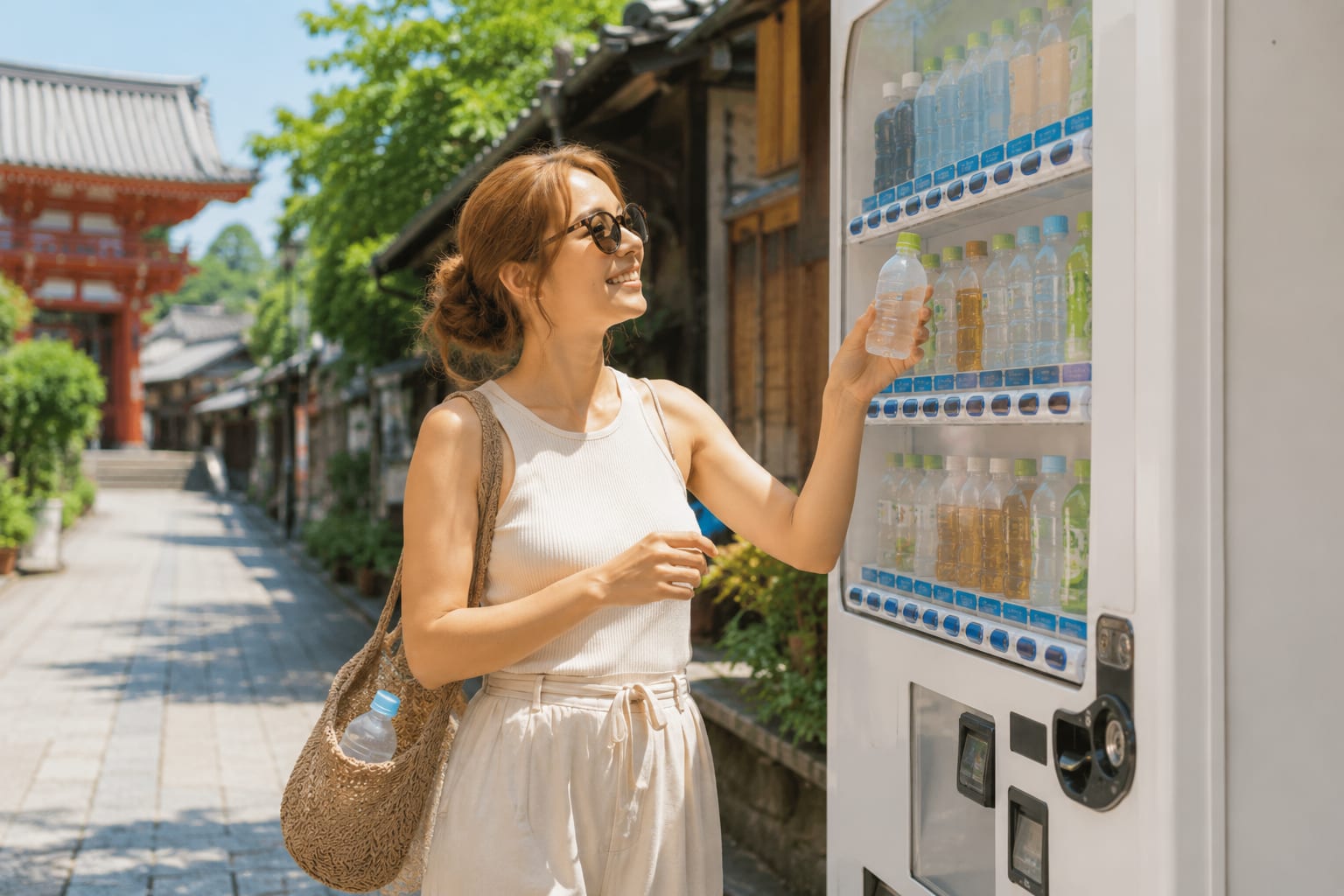
Sightseeing in Japan usually means long stretches outdoors.
Shrines, temples, gardens, castles, shopping streets. You can walk for hours without noticing. Between taking photos and finding the next stop, it is easy to forget to drink anything.
Carry a bottle so that you can drink whenever you want to.
In Japanese cities, convenience stores and vending machines are common, and water, tea, and sports drinks are easy to buy. Gardens, mountains, and sights outside the cities are different. There, a drink may not be available when you want one.
Pick up at least one bottle before you leave your hotel or the station.
Drink small amounts before you feel thirsty, rather than a lot at once afterwards. The Ministry of the Environment advises taking in water and salt regularly as a way to prevent heatstroke. If you have been sweating heavily, add something like a sports drink for salt and minerals rather than water alone.
Sugary drinks are not a good substitute for all of it. Alternate them with water or tea.
Do not pack the schedule too tightly
Most people want to see as much as possible in the days they have.
In summer, plan a lighter schedule than you normally would.
Hours of walking in the heat catch up with you. You can feel fine in the morning and be too tired to enjoy anything by the afternoon. Put rest into the plan from the start, instead of resting only once you feel unwell.
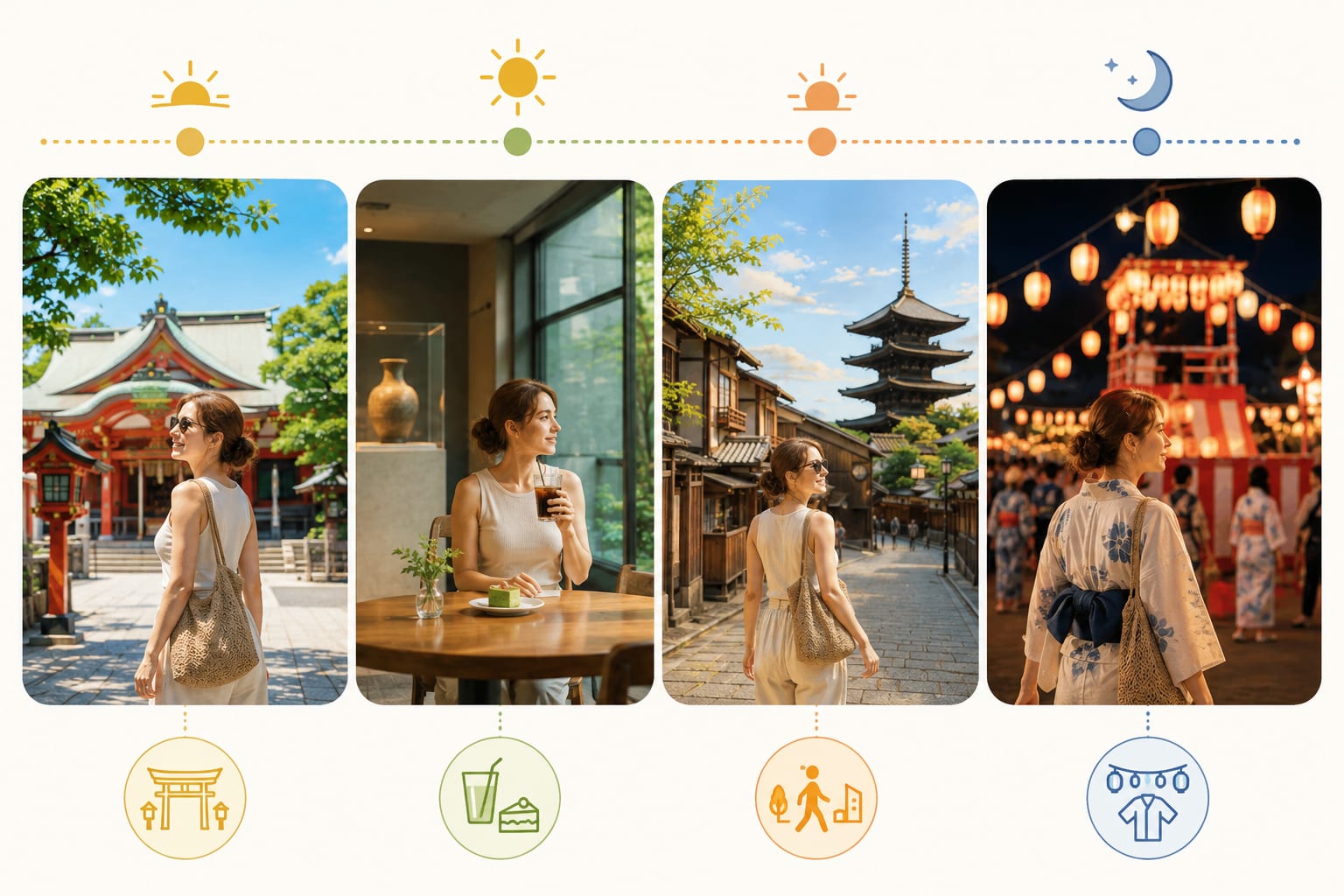
One way to structure the day:
- Visit shrines and temples in the cooler morning hours.
- Rest in a restaurant or cafe through the hottest part of the day.
- Spend the afternoon in a museum, gallery, or shopping centre.
- Go back outside in the early evening.
Plan around “can I enjoy the whole day without getting ill?” rather than “how many places can I fit in?”
Going into a cafe or a mall is not lost time. In a Japanese summer, cooling down indoors is part of the itinerary.
The Ministry of the Environment gives the same advice at the top of its scale: when the heat index is 31 or above, avoid going outside where you can, and move somewhere cool indoors.
Bring sunscreen
Short sleeves are fine in summer here. Sunscreen is the thing to make sure you have.
Japan is not as intense as the tropics, but summer sunlight is still strong. If your skin burns easily, or you are not used to being in the sun, hours outdoors can leave your skin red and sore. For some people it reaches the state of a mild burn.
One application in the morning is not enough. Reapply after you sweat, and after you wipe your skin with a towel. On a long day outdoors, a small bottle in your bag is easier to use than a large one in the hotel.
If you would rather cover up, these help:
- A light long-sleeved top or hoodie
- A hat
- Sunglasses
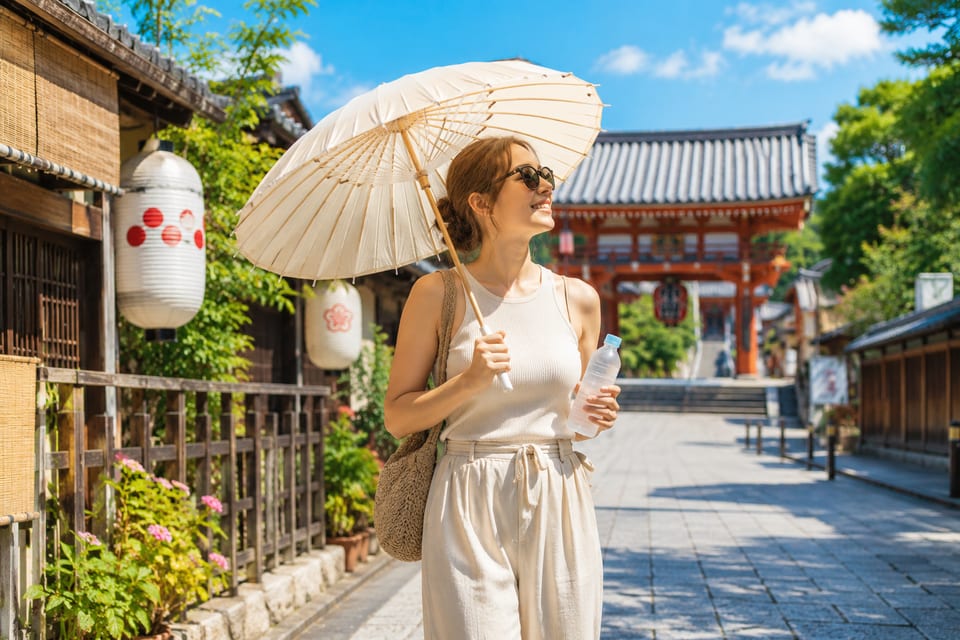
- A parasol that also works as a rain umbrella
The Ministry of the Environment lists parasols and hats among its heatstroke prevention measures, as a way to stay out of direct sun.
A light layer does double duty. It keeps the sun off outdoors, and it helps on trains and in shops where the air conditioning is strong.
Some visitors think of parasols as something only women carry. In a May 2019 release, the Ministry of the Environment stated that using a parasol is worthwhile regardless of gender from the point of view of heat stress. In the same release, it reported that people using a parasol that blocks 99% or more of solar radiation sweated about 17% less than people wearing only a hat. Use one whoever you are.
Cooling items you can buy in Japan
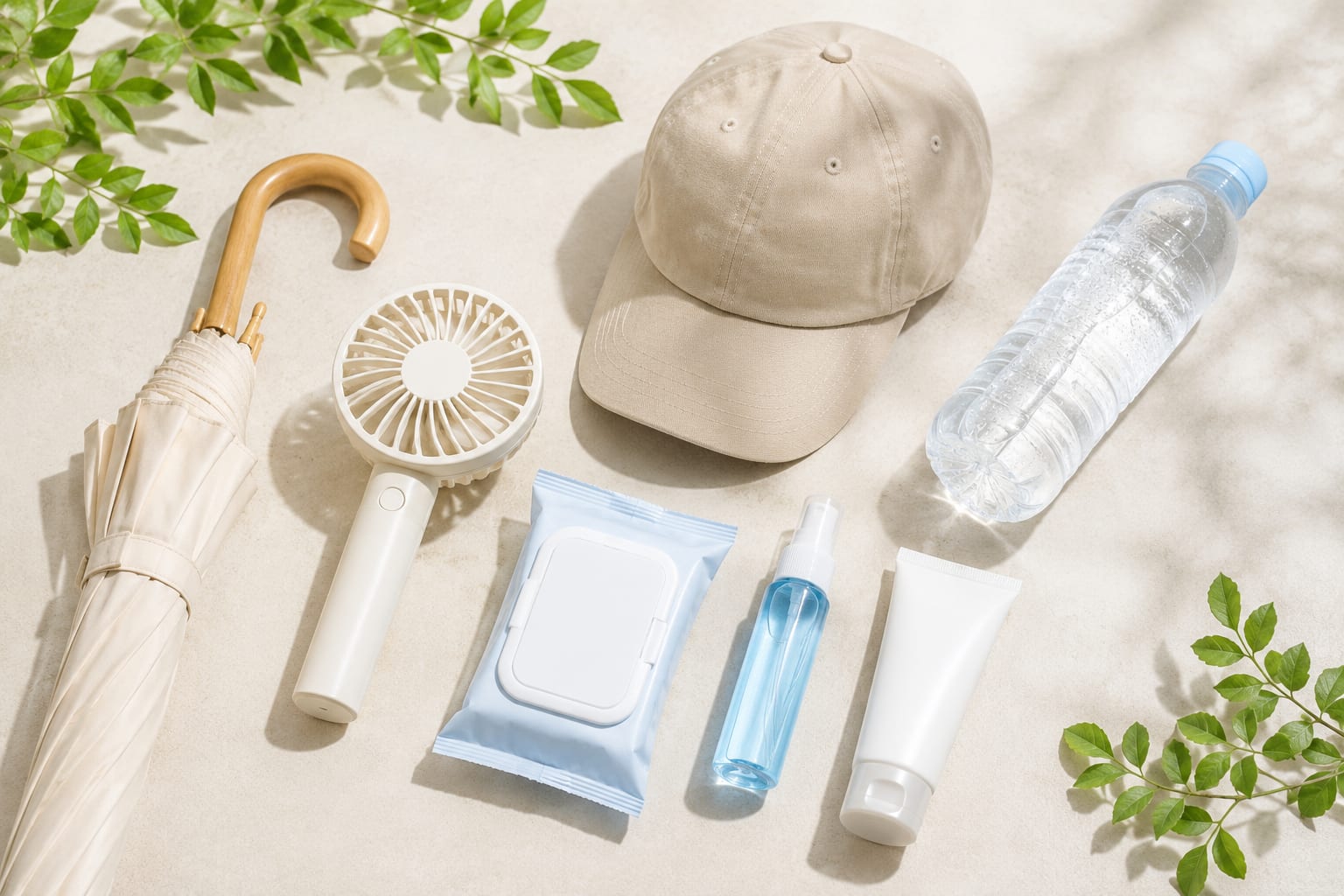
Convenience stores, drugstores, variety shops, and clothing shops in Japan all sell items for dealing with heat.
You do not have to bring everything from home. If the heat turns out to be worse than you expected, you can buy what you need here.
The shops named below are ones where the item is listed on the company’s own site, checked on August 4, 2026. Everything else is described by shop type. Stock and range change by store and by season.
A parasol that also works as a rain umbrella
If you buy one thing from this list, make it a parasol that doubles as a rain umbrella.
It keeps direct sun off you, which suits sightseeing on foot. It also helps in places with little shade, and while you are waiting in a queue.
Because it works in rain as well, you do not have to carry two umbrellas.
UNIQLO sells a UV Protection Compact Umbrella as a unisex product on its Japanese online store. The heat-shielding version is listed as blocking about 99% of UV and rated UPF50+. Variety shops and large shopping centres carry parasols too.
A rechargeable handheld fan
In summer here you will see a lot of people carrying small rechargeable fans.
They are useful on station platforms, at outdoor events, and in queues at theme parks. Versions exist that hang around your neck, stand on a desk, or include a cooling plate.
A handheld fan is a small comfort, not a solution.
In very hot conditions, it can end up blowing warm air at you. Do not treat it as protection. When the heat is severe, move somewhere with air conditioning.
MUJI lists several rechargeable handheld fans on its Japanese online store, checked on August 4, 2026. Electronics retailers and variety shops sell them as well.
Cooling body wipes
Cooling body wipes are useful after you have been sweating.
They take off sweat and stickiness and leave a cold feeling on the skin. They are easy to use before you go into a restaurant, or before you get on a train.
Convenience stores and drugstores both stock them, which makes them easy for visitors to find.
Some products contain a lot of menthol. If your skin is sensitive, choose a version made for sensitive skin or with a milder effect. Face and body versions are sometimes sold separately, so check the packaging for where the product can be used.
Cooling mist
Cooling mists come in versions for your skin and versions to spray on clothing.
They are useful when you come indoors from the heat, or when you want to freshen up partway through the day. Small sizes are sold for carrying around.
A cold sensation does not mean your body has actually cooled down inside. After using a mist, still drink and still rest.
Some products cannot be used near the eyes or face, or on broken skin. Read the instructions on the product.
An insulated holder for a plastic bottle
Cold drinks are easy to buy in Japan from convenience stores and vending machines, but outdoors in summer they warm up quickly.
An insulated holder keeps a bottle cold for longer.
It helps on a long day outdoors, or when you are going somewhere you cannot buy a drink easily. The trade-off is weight and bulk compared with carrying the bottle on its own.
For a short walk around a city it is not essential. At a theme park or a sight outside the city, it earns its place.
A portable ice pack or neck cooler
Ice packs and neck coolers that cool the neck are widely sold here in summer.
The Ministry of the Environment’s heat illness manual describes first aid for suspected heatstroke as cooling the front of the neck, the armpits, and the groin, where large blood vessels run close to the surface. Cooling your neck follows the same idea.
An ice pack you fill with water or ice can be reused as long as you can get ice at a hotel or a convenience store.
Versions that you freeze are different. If your accommodation has no freezer, you may not be able to use them properly. For travel, the fill-with-ice type is usually more practical.
A light hoodie with UV protection
A thin hoodie with UV protection covers two problems at once: sun outdoors, and cold air conditioning indoors.
Outside it keeps the sun off your arms and neck. On trains and in shopping centres it keeps you from getting cold.
Choose one that folds small and it will fit in a day bag. Clothing shops with branches across Japan, such as UNIQLO and MUJI, are a place to look.
Do not rely on the items alone
Cooling items make a summer trip more comfortable.
A parasol, a fan, and cooling wipes still do not prevent heatstroke.
The basics matter more:
- Drink regularly
- Take salt as well when you have been sweating
- Rest somewhere with air conditioning
- Avoid the hours with the strongest sun
- Cancel plans when you feel unwell
- Do not push through on too little sleep
The Ministry of the Environment lists taking in water and salt, keeping a cool environment, taking care when you feel unwell, and letting your body adjust to heat gradually. Travellers who have just arrived have not adjusted to the heat, so the first few days deserve the most caution.
School holidays and Obon crowds
School summer holidays in Japan vary by region and by school. In many areas they run from around late July to the end of August. Treat that as a rough guide rather than fixed dates.
More families travel and go out during this period, so sights, theme parks, and shopping areas are busier than usual.
Most schools start the new term in September, but the heat can continue. If you travel in September, plan for heat much as you would in midsummer.
The busiest period is Obon, in mid-August. JNTO describes August as a time of rest and family reunions, with many people returning home for the Obon rituals held in mid-August.
People travel home or take domestic trips during Obon. Shinkansen trains, flights, expressways, hotels, and popular sights all get crowded. Dates vary by region, so this guide treats it as mid-August rather than fixed days.
Book early where booking is possible:
- Reserved seats on Shinkansen and limited express trains
- Domestic flights
- Hotels
- Popular restaurants
- Theme parks
- Timed tickets for observation decks and galleries
- Popular experience programmes
For places that do not take bookings, go right after opening or in the morning, when they are usually less crowded.
Enjoy what only summer has
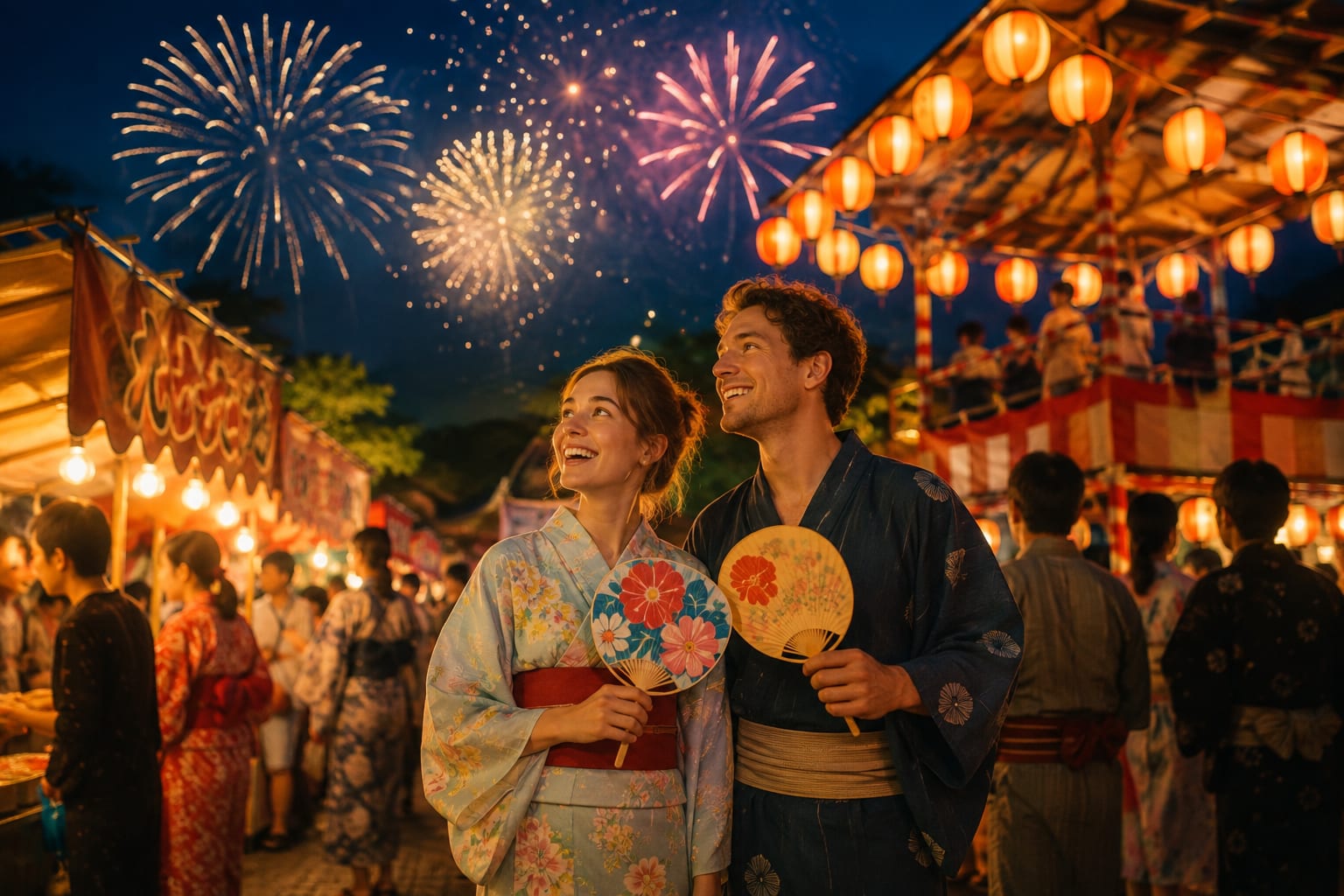
A summer trip to Japan comes with heat, humidity, sunburn, and crowds to plan around.
With enough preparation, it also gives you things no other season does.
Local summer festivals, fireworks in the night sky, food from festival stalls, and time at the sea or a river are all part of summer here.
Do not try to spend every hour of the trip sightseeing. Rest is part of the trip.
Check humidity and the “feels like” temperature as well as the number on the forecast, carry water, and stay out of direct sun. On the worst days, switch to an indoor plan instead of pushing on.
Sources9 checked
- Ministry of the Environment, "What is the Heat Index (WBGT)?"Checked 2026-08-04
- Ministry of the Environment, "Heatstroke Alert"Checked 2026-08-04
- Ministry of the Environment, "How to prevent and respond to heatstroke"Checked 2026-08-04
- Japan Meteorological Agency, "The urban heat island effect"Checked 2026-08-04
- JNTO, "Summer in Japan"Checked 2026-08-04
- UNIQLO, "UV Protection Compact Umbrella / Heat Shielding" product pageChecked 2026-08-04
- MUJI, "Rechargeable handheld fan with adjustable angle" product pageChecked 2026-08-04